 VapeWholesaleHub
Negotiating Lavender Ice Contracts With Overseas Factories — Updated for 2026
This page is written for the person who has to sign the purchase order, not for the person who designed the packaging. If you are weighing up lavender ice right now, the sections below follow the order in which the real decisions tend to arrive.
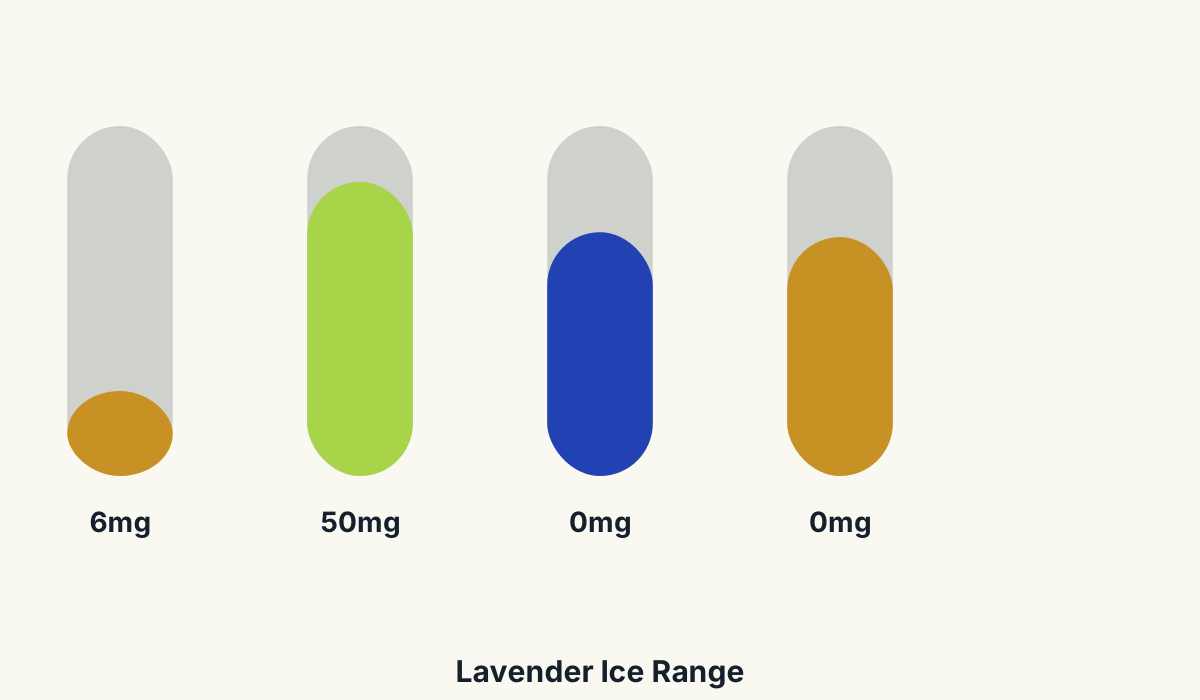
Where Lavender Ice Sits in the Range
A tight lavender ice range with deep availability usually outsells a wide range with thin stock. Customers who find their line in stock come back; customers who are told to wait do not.
Lavender Ice rewards retailers who can explain it in one sentence. If your team needs a paragraph, the range is too complicated for the space it occupies.
What to Fix Before Approving Lavender Ice
Specification sheets are where a lavender ice deal is won or quietly lost. Two samples can look and taste the same while using different coil wire, different wicking density and different tolerances on the mouthpiece. Those details decide how the unit behaves in week three rather than minute three.
| Product category | Refillable kit |
|---|---|
| Resistance band | 0.6 - 0.8 ohm |
| Capacity tolerance | +/- 5% |
| Puff count method | Machine cycle 3s on / 27s off |
| Master carton | 400 units |
| Carton weight | 8.6 kg |
| Shelf life | 24 months |
| Storage | 15-25 C, dry, away from direct light |
What Lavender Ice Really Costs Landed
Margin on lavender ice is rarely lost at the till. It is lost through dead stock, returns and emergency air freight. A slightly higher landed cost with predictable lead time usually beats the cheapest quote on the spreadsheet.
Indicative reference points for planning purposes: entry tier from USD 0.96 per unit at 2000 units, mid tier at USD 1.12, and volume tier at USD 0.85 for full container quantities. These figures move with specification, packaging and freight, so treat them as a shape rather than a quote.
Freight, Customs and Timing
Track lavender ice landed cost per unit as a running number, including duty and local delivery. It is the only figure that tells you whether a supplier change actually improved anything.
Inspection Before Dispatch
Random checks are fine, but weight the sample towards the start and end of a lavender ice production run. Those are where a line is most likely to drift.
Most defects in lavender ice are not dramatic. They are loose tolerances, a slightly thin seal, a mouthpiece that clicks. Left alone they turn into leak complaints, which are the single most common reason a retailer drops a line.
- Rotate stock by batch code rather than by delivery date.
- Model landed cost, not ex-works price, when comparing quotes.
- Ask how the factory measures puff count, then compare like with like.
- Agree the tolerance band in writing before approving artwork.
- Keep sealed retained samples from every production batch.
Trends Worth Watching
Expect lavender ice packaging requirements to keep tightening. Designs that leave room for additional labelling age better than tight layouts that need a full reprint to comply.
One shift worth planning for: shorter lavender ice reorder cycles with smaller average drops. It favours suppliers with flexible production slots over those who only want large annual commitments.
Practical Checklist
- Rotate stock by batch code rather than by delivery date.
- Ask how the factory measures puff count, then compare like with like.
- Start with a mixed carton and let your own sell-through decide.
- Agree the tolerance band in writing before approving artwork.
- Keep sealed retained samples from every production batch.
- Model landed cost, not ex-works price, when comparing quotes.
Frequently Asked Questions
What if I only need a small first order?
That is normal and sensible. A mixed carton lets you test lavender ice in your own market before committing to a production run, and the specification you approve at that stage carries through to larger orders unchanged.
Is there support for in-store material?
Yes. Shelf talkers, counter cards and simple planogram suggestions are available for lavender ice ranges that reach a sensible volume. Most retailers find the plain strength and flavour cards do the most work.
What if a batch does not match the sample?
Keep the retained samples from the approval stage. If a delivered batch measurably differs, we compare against the retained set and resolve it against the production record. This is why we insist on sealed retained units from every run.
Can I mix strengths in one order?
In most cases yes, as long as each strength meets the minimum run length. Mixed strength cartons are popular with retailers building their first display because they show the full ladder without over committing.
Can the packaging be customised?
Yes. Most lavender ice programmes use private label packaging once volumes justify the printing plate. We supply dielines, check your artwork for print issues and hold approved files so reorders need no new setup.
Next Step
Whatever you decide, decide it against numbers you can check on arrival. That single discipline removes most of the risk from importing lavender ice.
Related Reading
- Lavender Ice Escalation Path When Something Goes Wrong — High Volume Buyers
- Certification Routes for Lavender Ice in Different Markets — 2026 Edition
- Lavender Ice KPI Set for Wholesale Operations — UK and Ireland
- Lavender Ice Auditing Your Own Supply Chain — the Middle East
- Lavender Ice Quality Control: Tests We Run Before Dispatch — Low Minimum Quantities
- Lavender Ice Staff Training Notes for Store Teams — Before Your Next Order