 VapeWholesaleHub
Lavender Ice Quality Drift: Catching It Before Customers Do — Updated for 2026
Buyers often ask us to explain why two lavender ice samples that look identical behave differently after a month. The answer is almost always tolerance control, and it is more interesting than it sounds.
Positioning Lavender Ice on Your Shelf
Think about where lavender ice sits in your customer's week. If it is a weekly restock, breadth matters less than availability. If it is an occasional treat, flavour range and display story carry more weight.
Category planning for lavender ice works best when you map it against three shopper types: the restocker who already knows what they want, the switcher who wants something stronger, and the explorer who buys on flavour name alone.
Where Demand Is Heading
Flavour cycles in lavender ice are shortening, which argues for smaller test orders and faster feedback loops rather than large speculative buys on a predicted winner.
The lavender ice category is consolidating around suppliers who can document what they ship. Buyers who built that requirement into their process early are now finding it much easier to scale.
Getting Lavender Ice to Your Warehouse
Track lavender ice landed cost per unit as a running number, including duty and local delivery. It is the only figure that tells you whether a supplier change actually improved anything.
What Lavender Ice Really Costs Landed
Margin on lavender ice is rarely lost at the till. It is lost through dead stock, returns and emergency air freight. A slightly higher landed cost with predictable lead time usually beats the cheapest quote on the spreadsheet.
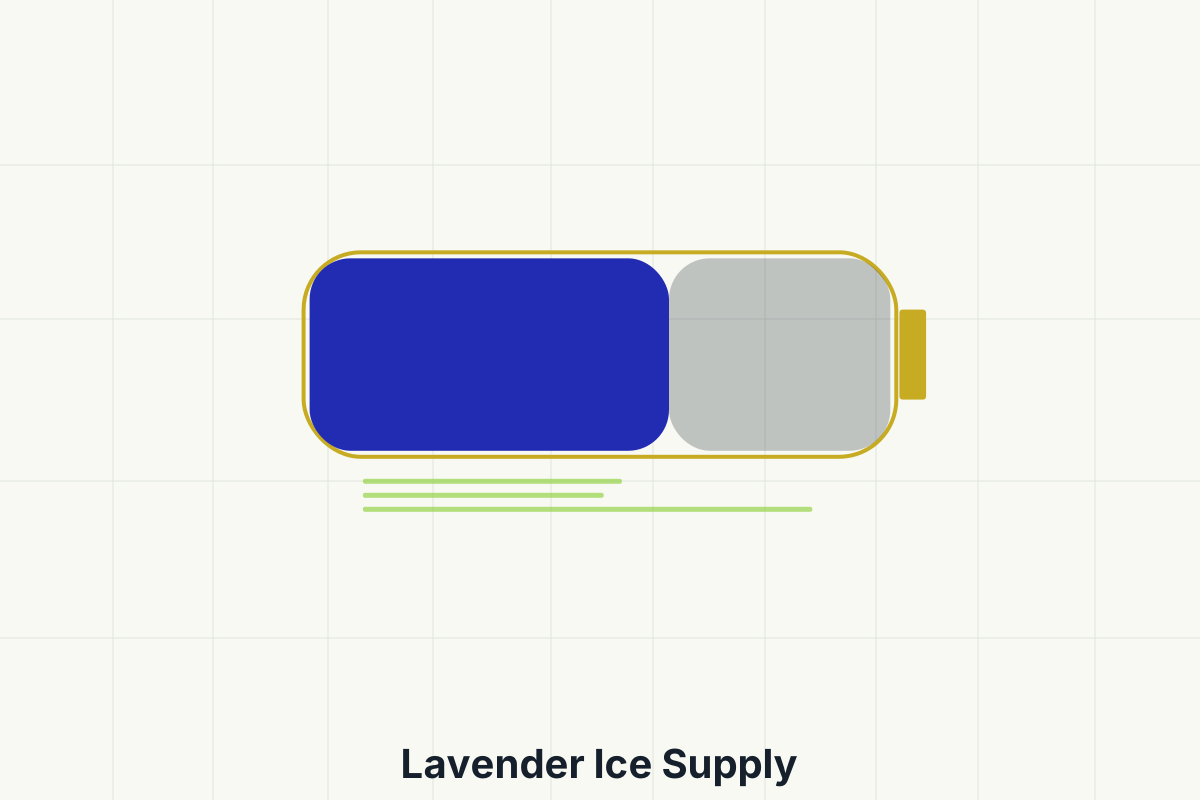
Indicative reference points for planning purposes: entry tier from USD 1.23 per unit at 2000 units, mid tier at USD 1.62, and volume tier at USD 0.96 for full container quantities. These figures move with specification, packaging and freight, so treat them as a shape rather than a quote.
Reading a Lavender Ice Spec Sheet
Revisit the lavender ice specification after every third order. Small improvements compound, and factories take a buyer more seriously when the document has clearly been used.
| Product category | Accessory |
|---|---|
| Resistance band | 0.8 - 1.0 ohm |
| Capacity tolerance | +/- 2% |
| Puff count method | Machine cycle 2s on / 18s off |
| Master carton | 200 units |
| Carton weight | 8.2 kg |
| Shelf life | 18 months |
| Storage | 15-25 C, dry, away from direct light |
Practical Checklist
- Check carton dimensions against your freight quote before confirming.
- Ask how the factory measures puff count, then compare like with like.
- Model landed cost, not ex-works price, when comparing quotes.
- Plan the switch from air to sea freight before you need it.
- Confirm the current customs classification with your own broker.
- Start with a mixed carton and let your own sell-through decide.
Frequently Asked Questions
How long does a lavender ice order take to arrive?
Production typically takes ten to eighteen working days after artwork approval, and transit depends on the method you choose. Air express is fastest, sea freight is cheapest at volume. We confirm both at quotation so there is no surprise later.
What happens if my market changes its rules?
Regulations move, and packaging or documentation sometimes has to follow. We keep approved artwork files on hand so that a required change is a reprint rather than a redesign, which keeps the cost and delay down.
Can you match an existing product I already sell?
Often yes, provided we can measure it properly. Send a physical sample and we will report back on what can be matched, what will differ slightly, and why. An honest gap is more useful than a vague promise.
What information do you need to quote?
Target specification, approximate quantity, destination and any packaging requirement. With those four we can usually come back with a costed option the same working day rather than a request for more information.
How are price changes handled on repeat orders?
{K} pricing is reviewed against input costs and volume rather than adjusted casually. Any change is confirmed in writing before the next order is scheduled, with the reason stated so you can judge it yourself.
Next Step
Questions that are not answered here are usually the interesting ones. Reach out with the specifics of your market and we will answer with numbers rather than adjectives.
Related Reading
- Lavender Ice Product Listings That Actually Convert — Tight Margin Categories
- Comparing Lavender Ice Factory Tiers and What You Get — a Factory Floor View
- Lavender Ice Customer Education That Reduces Complaints — Tight Margin Categories
- Lavender Ice vs Standard Alternatives: What Changes for Your Shelf — the Buying Desk
- Lavender Ice Freight Options Compared: Air, Sea and Express — EU Markets
- Negotiating Lavender Ice Contracts With Overseas Factories — Repeat Orders