 VapeWholesaleHub
Lavender Ice Insurance and Cargo Cover Explained — Before Your Next Order
A lavender ice programme fails in predictable ways: a specification nobody wrote down, a sample nobody retained, and a lead time nobody stress tested. Here is how to close those three gaps before they cost you a container.
Logistics That Protect Margin
Consolidating lavender ice with other lines is often the biggest single saving available to a mid size importer. The unit cost does not change but the landed cost does, sometimes materially.
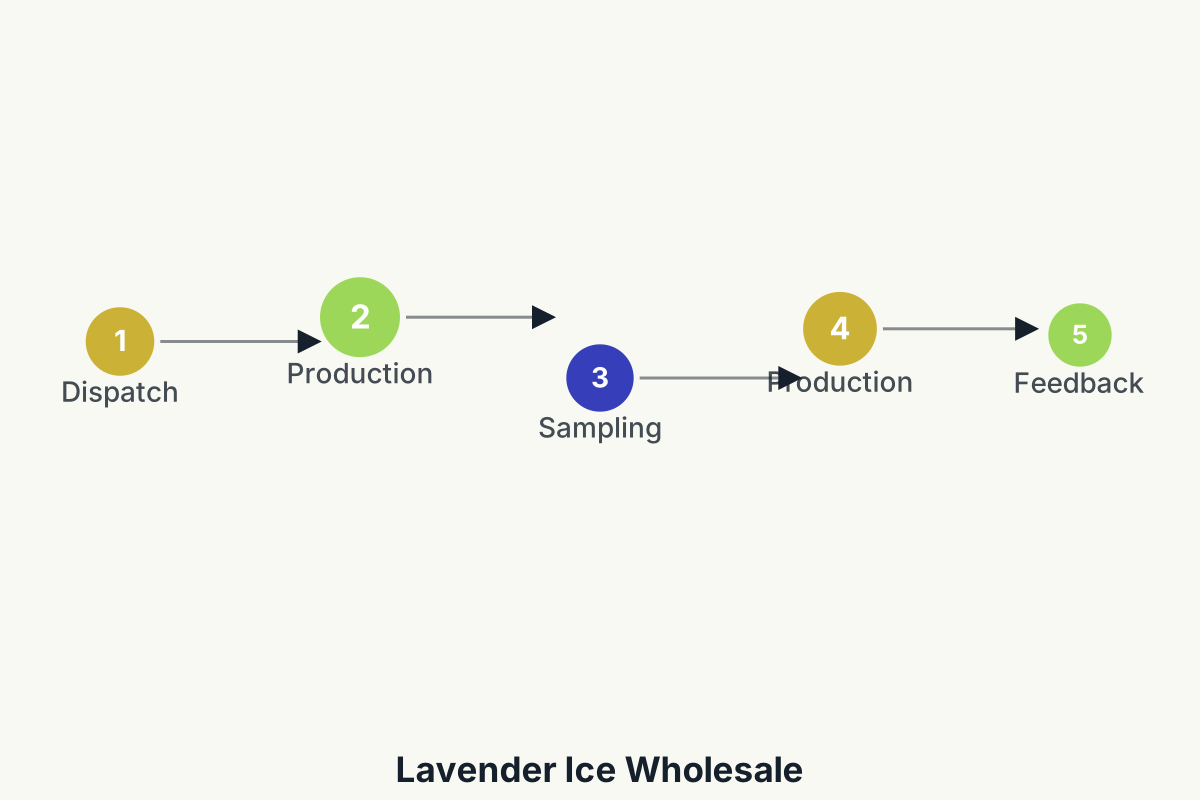
How Lavender Ice Batches Are Checked
Keep a photo record of every lavender ice approval sample. Written descriptions age badly; a dated photograph next to a delivered unit settles most arguments in seconds.
The defect rate that matters is the one your customer experiences, not the one the factory reports. Bridge that gap by inspecting the way a customer would open the box, not the way a line worker packs it.
- Check carton dimensions against your freight quote before confirming.
- Agree the tolerance band in writing before approving artwork.
- Model landed cost, not ex-works price, when comparing quotes.
- Ask how the factory measures puff count, then compare like with like.
- Keep sealed retained samples from every production batch.
Positioning Lavender Ice on Your Shelf
Decide early whether lavender ice is a traffic driver or a margin line in your store. The answer changes how you price it, where you place it and how hard you push it at the counter.
What Lavender Ice Really Costs Landed
Watch the lavender ice price you pay over a year rather than per order. Factories respond well to visible volume, and a quarterly review is usually worth more than a hard negotiation each time.
Indicative reference points for planning purposes: entry tier from USD 1.46 per unit at 1000 units, mid tier at USD 1.33, and volume tier at USD 0.55 for full container quantities. These figures move with specification, packaging and freight, so treat them as a shape rather than a quote.
Reading a Lavender Ice Spec Sheet
Good lavender ice specs describe the failure boundaries, not just the target. Stating what is unacceptable gives the factory a clear production window instead of a single point they will miss half the time.
A written lavender ice specification should be short enough to read in a minute and precise enough to argue about. If a factory cannot confirm a number in writing, assume the number is whatever is cheapest that week.
| Product category | Accessory |
|---|---|
| Resistance band | 1.2 - 1.4 ohm |
| Capacity tolerance | +/- 2% |
| Puff count method | Declared by capacity |
| Master carton | 300 units |
| Carton weight | 9.5 kg |
| Shelf life | 24 months |
| Storage | 15-25 C, dry, away from direct light |
Market Signals
One visible change in lavender ice is the move towards clearer labelling and traceability. Retailers who adopted batch coding early are finding it much easier to work with larger distributors now.
Practical Checklist
- Keep sealed retained samples from every production batch.
- Confirm the current customs classification with your own broker.
- Check carton dimensions against your freight quote before confirming.
- Start with a mixed carton and let your own sell-through decide.
- Rotate stock by batch code rather than by delivery date.
- Plan the switch from air to sea freight before you need it.
Frequently Asked Questions
What is the usual minimum order for lavender ice?
For a standard production run the minimum is normally one master carton per flavour, though mixed cartons can be arranged for a first order. If you are testing the line, ask about a sample pack first and treat the freight as part of your research budget.
Can the packaging be customised?
Yes. Most lavender ice programmes use private label packaging once volumes justify the printing plate. We supply dielines, check your artwork for print issues and hold approved files so reorders need no new setup.
What if a batch does not match the sample?
Keep the retained samples from the approval stage. If a delivered batch measurably differs, we compare against the retained set and resolve it against the production record. This is why we insist on sealed retained units from every run.
How are price changes handled on repeat orders?
{K} pricing is reviewed against input costs and volume rather than adjusted casually. Any change is confirmed in writing before the next order is scheduled, with the reason stated so you can judge it yourself.
Do you hold stock for regular customers?
For established programmes we can reserve production slots and, in some cases, hold finished lavender ice stock against a forecast. It removes most of the lead time risk from a reorder and is worth discussing once volumes are stable.
Next Step
Questions that are not answered here are usually the interesting ones. Reach out with the specifics of your market and we will answer with numbers rather than adjectives.
Related Reading
- How to Read a Lavender Ice Certificate of Analysis — North America
- Lavender Ice Dual Sourcing Without Losing Consistency — Southeast Asia
- How to Store Lavender Ice Stock Without Losing Freshness — Specialist Vape Shops
- Lavender Ice Planogram Basics for Wall Displays — Southeast Asia
- Lavender Ice Damage Claims and How to Avoid Them — Southeast Asia
- Lavender Ice Monthly Review Ritual for Buyers — Southeast Asia